Frozen Gutters and Downspouts in the Lower Mainland
Vancouver winters are mild more often than not, but a cold snap still finds every gutter with debris sitting in it. Here is why frozen gutters and downspouts happen here, how to thaw one from the ground, and how to stop most of it before the cold arrives.
Frozen gutters and downspouts show up somewhere in the Lower Mainland almost every winter, even though the climate here is wet and mild far more often than it is cold. A run of nights below freezing in December, January or February is all it takes to turn a gutter full of wet leaves and moss grit into a solid block of ice, and once a downspout is plugged, meltwater has nowhere to go but over the edge and down the siding. The debris sitting in the channel is almost always the reason the ice forms in the first place. A clean, well-pitched gutter empties within minutes of a rain and rarely holds enough standing water to freeze solid.
Why do gutters and downspouts freeze?
Gutters and downspouts freeze when standing water in the channel or the bottom elbow drops below zero during a cold snap, and in this region that water is almost always here because debris trapped it there. A gutter free of leaves and needles drains within minutes of a rain and rarely has enough water sitting in it to freeze solid.
Arctic outflow events, the cold dry wind that funnels down through the Fraser Canyon and out across the valley, can hold temperatures below freezing for several days at a stretch, and that is usually when calls about frozen downspouts start coming in. Higher ground in Langley, Maple Ridge and Abbotsford, and the North Shore mountainsides above West Vancouver and North Vancouver, see more of these cold snaps and more snow than Vancouver or Richmond, so ice problems tend to cluster there first.
How do you thaw a frozen downspout safely?
Most frozen downspouts can be cleared from the ground without a ladder. Work from the bottom up and go slow. Ice already puts a downspout under pressure, and forcing it can split the seam.
- Find the blockage. Run a hand down the downspout from the bottom elbow. A dull, solid feel means ice; a hollow sound higher up means the block is further up the run.
- Pour warm water into the bottom elbow first, not the top. This melts an escape channel instead of stacking more water on top of the ice.
- A hair dryer on low heat can help, but only from a GFCI-protected outdoor outlet, and never pointed into standing water or used in the rain.
- Tap the downspout gently with an open hand or a rubber mallet to loosen ice, working from the bottom toward the top.
- Clear the ground-level outlet or splash block last, once water starts moving, so the melt has somewhere to drain.
What not to do: do not chip at the aluminum with a screwdriver or ice pick, since it dents and splits far more easily than people expect. Skip the propane torch near siding or soffit, stay off an icy ladder, and never throw rock salt onto the roof edge to speed things up.
How do you remove ice from an eavestrough?
Ice sitting inside an eavestrough is often safest left alone until the next mild spell melts it, since chipping at ice from a ladder in freezing weather is one of the more common ways homeowners get hurt on winter gutter work. If the gutter is overflowing or starting to pull away from the fascia, that is the point to call for help instead of climbing up.
Calcium chloride ice-melt socks, mesh tubes filled with the same product used on driveways, laid along a gutter can open a drainage channel without a ladder trip, though they are a stopgap rather than a fix. Rock salt is a poor substitute for it: it corrodes aluminum and steel gutter hardware over a season or two, and the runoff will kill nearby plants and lawn. If ice has built up enough weight to pull a hanger loose or tip a run away from the roofline, that is a job for a gutter repair, not more ice removal.
Why do icicles form on gutters?
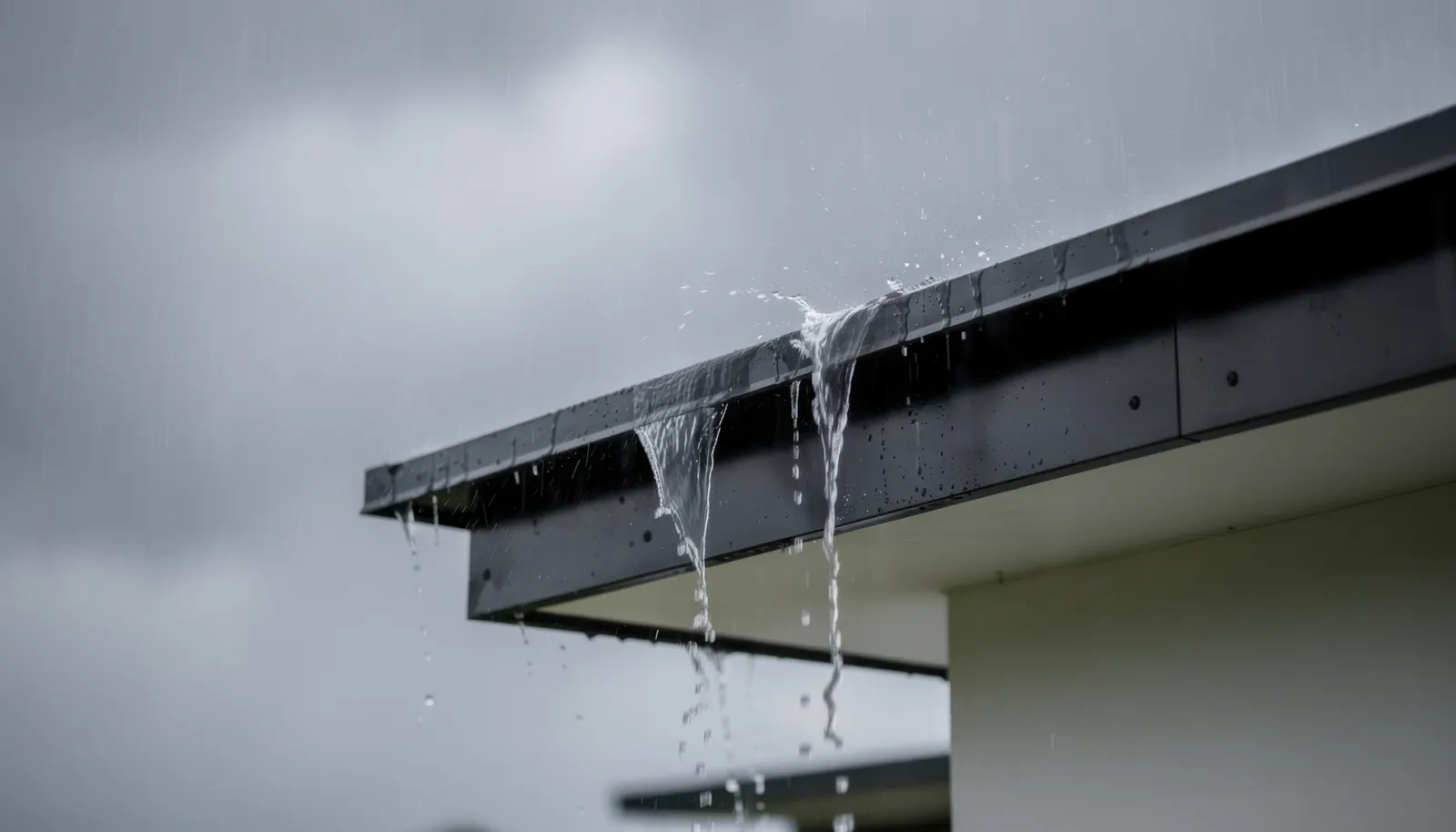
Icicles form through a melt-refreeze cycle: daytime sun or heat escaping from the attic melts snow on the roof, that water runs to the gutter edge, and it refreezes overnight as the temperature drops again. A gutter already blocked with debris gives that meltwater nowhere to drain, which is why icicles tend to hang from the same runs every winter.
How to keep gutters and downspouts from freezing
- Clean gutters in late November, before the first real cold snap, so there is no leaf or needle debris left to hold water. See our guide on how often gutters should be cleaned and the best time to clean gutters in Vancouver.
- Check that downspout extensions carry water well clear of the foundation and are not buried under a snowbank or a pile of leaves. Our downspout cleaning service confirms every run drains freely.
- Confirm the gutter run has a slight slope toward the downspout. A flat or reverse-pitched section holds water year round and is the first place to freeze.
- Heat cable along a run that freezes every year is an option, run on its own circuit and installed by an electrician, never plugged into an outdoor extension cord.
- Recurring icicles on the same section usually point to attic heat loss, so more insulation and ventilation up there does more long term than anything done at the gutter.
Ice dams in the Lower Mainland
Ice dams, the ridge of ice that backs meltwater up under the shingles, are less common here than in colder inland climates, but they do show up after a heavier snowfall on North Shore and Fraser Valley homes with attic heat loss. Gutter guards on their own rarely cause them, though some mesh and reverse-curve designs can hold a shelf of snow at the edge instead of letting it slide off, and that shelf feeds the same melt-refreeze cycle. See our comparison of gutter cleaning vs gutter guards and our gutter guard installation guide for how different designs handle winter weather.
When to call us
Call if ice has pulled a gutter section away from the fascia, if a downspout has split from ice pressure, or if water is getting in behind the fascia board and running down the siding. Most of that is a spring repair job once things thaw, not something to force in freezing weather from a ladder. The cheaper fix is booking a late-November cleaning before the cold arrives, since a debris-free gutter is the biggest reason some houses never freeze up at all. See our gutter repair page if a run needs fixing once the ice is gone.
Winter Gutter Checklist
Clear all debris before the first cold snap
Keep clear of snow and leaf piles
Check for flat or sagging sections
Check attic insulation and ventilation
Call for a repair, not more ice removal
Frozen Gutters and Downspouts, FAQ
Clear gutters freeze less. Book a late-November cleaning.
Free quotes, all Lower Mainland.