Can Clogged Gutters Cause Basement Leaks?
Yes, clogged gutters can cause basement leaks, and in Vancouver they are one of the first things worth ruling out. Here is how overflow turns into a wet basement wall, the signs that point at your gutters, and the other causes a gutter crew cannot fix.
Can clogged gutters cause basement leaks? Yes, they can. When a gutter fills with maple leaves, cedar needles and moss grit, rain spills over the front edge and lands against the foundation. Vancouver gets about 1,150 mm of rain a year, much of it in November to March storms, so that soaked strip of soil can stay wet for weeks. Gutters are a common cause of basement water, not the only one. If your gutters have not been cleared lately, start with gutter cleaning in Vancouver before you spend money on anything bigger.
How do clogged gutters get water into your basement?
A clogged gutter cannot carry water to the downspout, so it overflows along the roof edge and drops beside the foundation. That water soaks the soil, builds pressure against the basement wall, and finds its way in through cracks, joints and window wells. It is a slow chain of events, which is why the leak often shows up weeks after the clog.
- The gutter fills and overflows. A run packed with leaves and moss grit holds water until it spills over the front lip in a sheet, often at a corner or an inside bend where debris piles up first.
- The sheet lands at the wall. Instead of being carried away by the downspout, the roof's water falls straight down beside the footing, usually onto the garden bed.
- The soil saturates. Lower Mainland clay and fill soils drain slowly. After a few days of November rain the ground next to the wall can be wet through, even if the surface looks fine.
- Pressure builds. Saturated soil holds water against the foundation and pushes on it. This is called hydrostatic pressure, and it grows with the depth of water in the soil.
- Water finds an entry point. It seeps through hairline cracks, the cold joint where the wall meets the floor slab, tie holes left from the forms, and window wells that fill and cannot drain.
A working perimeter drain (also called drain tile) is meant to catch this water at the footing and carry it to the storm connection. The City of Vancouver notes that foundation drains and roof leaders are directed into the storm sewer. A drain that is old, silted up or overwhelmed by a heavy roof overflow can fall behind, and then the water goes where it can.
What are the signs your gutters are behind the wet basement?
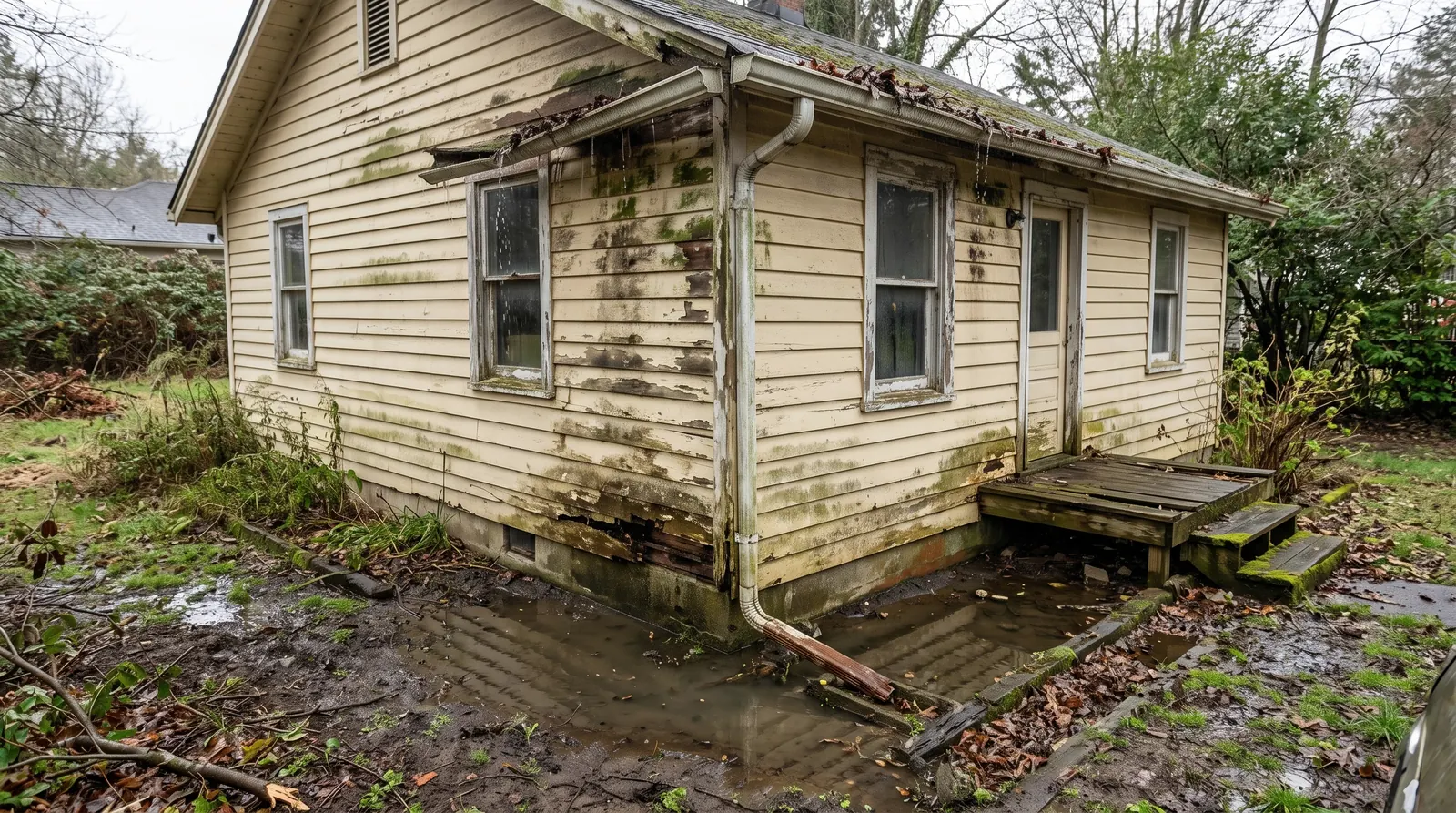
The strongest sign is a wet spot that lines up with a place where your gutter overflows and only appears after heavy rain. Stains on the wall below the overflow, a washed-out strip in the garden bed, and water lines on the siding all point at the roof edge. Leaks in dry weeks usually point elsewhere.
- Damp patches or white mineral staining (efflorescence) on the basement wall directly below a spot where the gutter spills
- Wet spots that show up after a hard rain and dry out within a few days
- Splash marks, bare soil or a small erosion trench in the garden bed under the gutter
- Vertical water lines or dark streaks on the siding below the gutter
- Overflow you can actually see during a storm: water pouring over the front edge instead of running to the downspout
The overflow test is the easiest. Stand under cover during the next heavy rain and watch the gutters. If water sheets over the edge near a corner or mid-run, that is where your water is landing.
What other causes of basement water should you rule out?
Clogged gutters are only one source. Grading that slopes toward the house, a failed or clogged perimeter drain, downspouts that dump too close, a high water table and a cracked foundation all let water in. If the gutters are clean and the basement still leaks, one of these is likely the cause.
- Grading toward the house. Ground, patios or walkways that slope toward the wall send rain straight to the foundation. CMHC's guidance says to slope grading away from the foundation to divert water from the walls.
- A failed or clogged perimeter drain. Older drain tile can fill with silt or roots. A drainage contractor can scope it with a camera.
- Downspouts too close or disconnected. A split joint, a missing extension or a crushed underground connection puts roof water at the footing even when the gutter is clear.
- A high water table. In wet months, parts of Richmond, Delta and low-lying Vancouver sit on ground that is already close to saturated. Gutters cannot change that.
- A cracked foundation. A crack that leaks in dry weather, keeps widening or comes with a bowing wall needs a foundation specialist.
We clear and flush gutters and downspouts. We do not dig, repair drain tile or fix cracks, and we will not promise that cleaning alone will dry your basement.
What should you do this week?
Clear the gutters and downspouts, check where each downspout empties, look at the ground slope along the wall, and watch the next heavy rain. Those four steps take an afternoon and show whether the roof edge is your problem. A common guideline is to discharge roof water 1.5 to 2 metres (5 to 6 feet) from the foundation.
- Clear the gutters and downspouts. Get the maple leaves, cedar needles and moss grit out of every run, then flush each downspout until it runs clear at the bottom. Our eavestrough cleaning and downspout cleaning pages explain what a full clean covers.
- Check where each downspout ends. It should either discharge 1.5 to 2 m from the wall onto ground that slopes away, or be connected properly to a storm line that is not broken or blocked.
- Check the grading. Look along each wall for soil that has settled or slopes toward the house, and for patios or walkways that tilt the same way.
- Watch the next rain. Stay dry and look at the roof edge. If water still pours over a clean gutter, the problem is slope, size or damage, not debris.
- Check the basement afterward. Note any new damp spots and where they sit compared with the overflow points. Take photos with the date.
Only clear gutters from a ladder if you are comfortable at height. Our guide on how to clean gutters safely covers the basics, and a two-storey roof is a job for a crew.
When is gutter repair or replacement the real fix?
If the gutters are clean and still overflow, the gutter system itself is the problem. Sagging runs that hold water, open seams, undersized troughs and too few downspouts all spill water at the wall. That calls for repair or new gutters, not another cleaning. Cleaning only helps when debris was the cause.
- A run that has pulled away or sagged so water pools and spills over the front: see gutter repair for what a repair visit covers.
- Seams and corners that drip straight down the wall, or metal that is past patching: our gutter replacement cost page explains what drives the price of new gutters.
- Built-in or box gutters that leak inside the roof edge, where the water you see in the basement started out of sight: hidden gutter repair covers those systems.
A site visit is the only way to tell which of these applies. We will tell you plainly if what you describe sounds like a drainage or foundation problem instead.
Wet Basement Checklist
Watch the roof edge in a heavy rain
1.5 to 2 m from the wall, or properly connected
Ground should slope away from the house
Call a drainage or foundation contractor
Structural, not a gutter job
Can clogged gutters cause basement leaks? Common questions
Want the gutters ruled out before the next storm?
Free quotes, all Lower Mainland.